
Play for Fun Mechanics in Demo Mode — King Kong Cash Slot
Watching the Reels Before Chasing the Wins
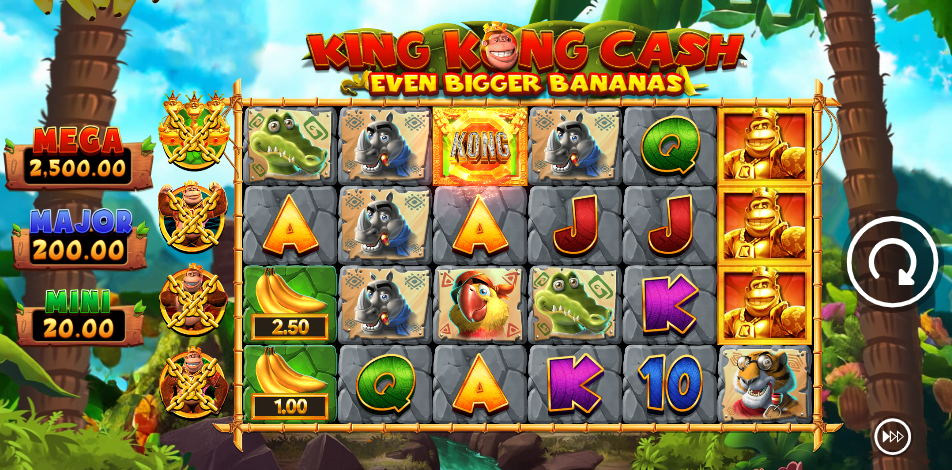
When I sit down to examine a slot properly, I rarely begin with real money. I begin by watching. Playing in demo mode, or play for fun as it is often called, allows me to observe a machine without pressure, without urgency, and without the distortion that risk inevitably introduces. It is the closest thing to looking under the bonnet while the engine is still running.
King Kong Cash is a particularly suitable game for this kind of observation. It is not a slot that overwhelms the player with constant visual noise or relentless features. Instead, it reveals itself gradually. Its pacing, the spacing between events, and the way small outcomes are distributed all become clearer when one plays without the distraction of balancing losses against expectations.
Many players treat demo play as a brief test, a way to see whether a game loads or whether they like the theme. That misses its real value. A slot is not defined only by its symbols or paytable. It is defined by how it moves, how it breathes over time, and how a sequence of spins forms patterns of anticipation and release. Those patterns cannot be understood in two minutes, and they are much easier to recognise when no real stakes are involved.
In King Kong Cash, this process is particularly revealing. The base game establishes a rhythm that is neither frantic nor idle. Small returns appear often enough to keep the reels conversational rather than silent, while features emerge in a way that feels structured rather than abrupt. Demo play makes these qualities visible, because the player is free to focus on behaviour rather than outcomes.
What follows is not a guide to winning, nor a catalogue of promises. It is simply a close look at how this slot behaves when played for fun, and what that behaviour can teach a careful observer.
Play for Fun in King Kong Cash — What Actually Changes and What Does Not
One of the most persistent misconceptions about demo play is the idea that it represents a simplified or altered version of the real game. In well-designed modern slots, including King Kong Cash, that is not how the system works. The reels spin according to the same rules, the same symbol distributions, and the same underlying random processes. The structure of the game remains intact.
What changes is not the machine but the context in which it is experienced.
In play-for-fun mode, the credits displayed on the screen are virtual. They can usually be replenished instantly, and their disappearance carries no consequence beyond the visual. This single difference has a surprisingly large effect on how a session unfolds. A player is more willing to continue through quieter stretches, more patient in observing patterns, and more inclined to experiment with stake levels or autoplay settings.
From an analytical point of view, this freedom is extremely useful. King Kong Cash does not rely on rapid-fire excitement. Its base game establishes momentum gradually, and certain aspects of its design only become apparent after dozens of spins. Demo mode allows those longer sequences to be observed without interruption.
Another important detail is that demo play reveals pacing more clearly than real play. When money is involved, attention often narrows to immediate outcomes. Wins and losses dominate perception, and subtle elements such as spin speed, animation timing, and the spacing of small returns become background noise. Remove the financial tension, and those same elements come forward. The player begins to notice how often the reels produce partial combinations, how frequently small line hits appear, and how the game maintains engagement even when no major feature is triggered.
King Kong Cash benefits from this kind of observation because its design relies on continuity. The base game is not merely a waiting room for bonus rounds. It has its own cadence, supported by regular visual feedback and moderate, steady activity on the reels. In demo mode, this cadence can be experienced as a whole rather than as a series of isolated results.
There is also a psychological aspect worth mentioning. Playing for fun changes the tempo of decision-making. Spins are less hurried. Pauses between rounds are longer. Players are more likely to adjust settings, explore the paytable, or simply watch the reels without immediately pressing spin again. These small changes create a calmer session, and in that calmer environment the structure of the game becomes easier to read.
For anyone who wishes to understand how a slot truly operates, this is invaluable. Demo mode turns King Kong Cash from a sequence of uncertain wagers into something closer to a study in motion. The mechanics do not change, but the perspective does, and that difference is enough to reveal details that are otherwise easy to miss.
Inside the Machine — The Core Mechanics of King Kong Cash Explained Clearly
A quick snapshot of how the game is put together
Use this as a fast reference while reading the mechanics section — it summarises what each core element does during a normal spin and feature cycle.
| Game element | Role in the game |
|---|---|
| Reels | Where outcomes are formed on every spin. |
| Paylines | How symbol combinations are counted and paid. |
| Wild symbols | Helping to complete winning lines by substituting for other symbols. |
| Scatter symbols | Triggering feature states such as free spins or bonus rounds. |
| Bonus features | Changing the pace of play and adding extra outcome paths beyond the base game. |
Before examining how a slot behaves over time, it is essential to understand the structure that drives that behaviour. King Kong Cash is built on a traditional reel-and-payline format, and that familiarity is part of its strength. The game does not depend on complicated rule sets to create engagement; instead, it relies on the interaction of straightforward elements working together in a steady, readable way.
The layout consists of five reels arranged across a fixed grid, with a set number of paylines determining how winning combinations are evaluated. Each spin produces a complete result in a single motion, and the evaluation of symbols follows clear, consistent rules. There are no cascading reels or multi-stage transformations in the base game, which means that each outcome stands on its own and contributes to the rhythm of play rather than interrupting it.
The symbol set is organised in the familiar hierarchy found in many video slots. Lower-value symbols appear frequently and are responsible for maintaining movement in the game. They create small returns and partial combinations that prevent long stretches of silence on the reels. Higher-value symbols appear less often, but when they align, they produce more noticeable results and add weight to the session.
Wild symbols serve their expected function, substituting for others to complete winning lines. Their role in King Kong Cash is not merely technical; they act as a visual signal of potential, often appearing in positions that suggest possibilities even when a full combination does not form. This contributes to the sense that the reels are active rather than inert.
Scatter symbols introduce the features that give the slot its broader structure. When these symbols land in the required configuration, the game shifts into a different mode, typically involving free spins or bonus mechanics that temporarily alter the conditions of play. These features are not constant interruptions but occasional changes of pace, and their spacing is an important part of the game’s character.
Another element worth noting is the way the game communicates outcomes. Animations are deliberate rather than excessive. Wins are acknowledged clearly but not exaggerated to the point of distraction. The sound design supports the visual feedback without overwhelming it. These details may seem minor, but they play a significant role in shaping the experience over longer sessions.
In demo mode, these mechanics can be observed without urgency. One begins to notice how often particular symbols appear, how frequently partial combinations form, and how the balance between small and moderate wins is maintained. Over time, the structure of the game becomes familiar, and the reels begin to feel less random in a chaotic sense and more random within a recognisable framework.
That framework is the foundation upon which everything else rests. Without understanding these core mechanics, it is difficult to interpret the rhythm of the game, because rhythm emerges from repetition, and repetition is governed by the rules embedded in the reels.
The Rhythm of the Base Game — How King Kong Cash Moves Over Time
Session activity over 150 spins (illustrative pattern)
This is not real performance data. It is a simple example of how a session can feel: quieter phases, short clusters of higher activity, and occasional feature spikes.
If mechanics describe what a slot can do, rhythm describes how it behaves while doing it. This is the aspect of play that many players sense instinctively but rarely examine closely. Demo mode provides the opportunity to observe it with patience.
In King Kong Cash, the base game unfolds at a measured pace. Spins resolve quickly enough to maintain continuity, yet not so quickly that the player feels rushed. The intervals between outcomes feel balanced, creating a tempo that encourages steady play rather than impulsive repetition. Over dozens of spins, this tempo becomes predictable in the best sense of the word: not predictable in results, but predictable in feeling.
Small wins appear often enough to maintain engagement. They do not dominate the session, but they prevent long stretches of complete inactivity. These modest returns act as punctuation marks in the flow of play, reminding the player that the reels are active even when larger combinations are absent.
Equally important are the near misses. These moments, when reels stop just short of forming a stronger combination, are part of the natural language of slot design. In King Kong Cash, they occur with enough frequency to create anticipation without becoming intrusive. The player notices them, registers the possibility they suggest, and moves on to the next spin without a sense of manipulation.
Visual feedback contributes significantly to this rhythm. The movement of the reels, the timing of symbol reveals, and the pace of animations all work together to establish a consistent cadence. Nothing feels hurried, and nothing lingers longer than necessary. The result is a flow that becomes almost conversational, as though the game and the player are exchanging gestures rather than shouting for attention.
Over longer demo sessions, another pattern becomes apparent: the alternation between quiet stretches and more active sequences. A series of spins may pass with only minor returns, followed by a cluster of moderate wins or an approach toward a feature trigger. This ebb and flow creates a sense of progression, even though each spin is technically independent of the last.
What makes demo mode particularly valuable here is the absence of tension. Without the pressure of real stakes, the player is more likely to notice these cycles. The mind begins to track sequences rather than isolated outcomes, and the session takes on a shape that would otherwise be obscured.
King Kong Cash is not a game designed to overwhelm. Its rhythm is steady, deliberate, and surprisingly easy to follow once one pays attention. Watching that rhythm emerge over time is one of the most instructive aspects of playing for fun, because it reveals how much of the experience of a slot is determined not by single events, but by the spaces between them.
When the Game Changes Pace — How Bonus Features Behave in Demo Play
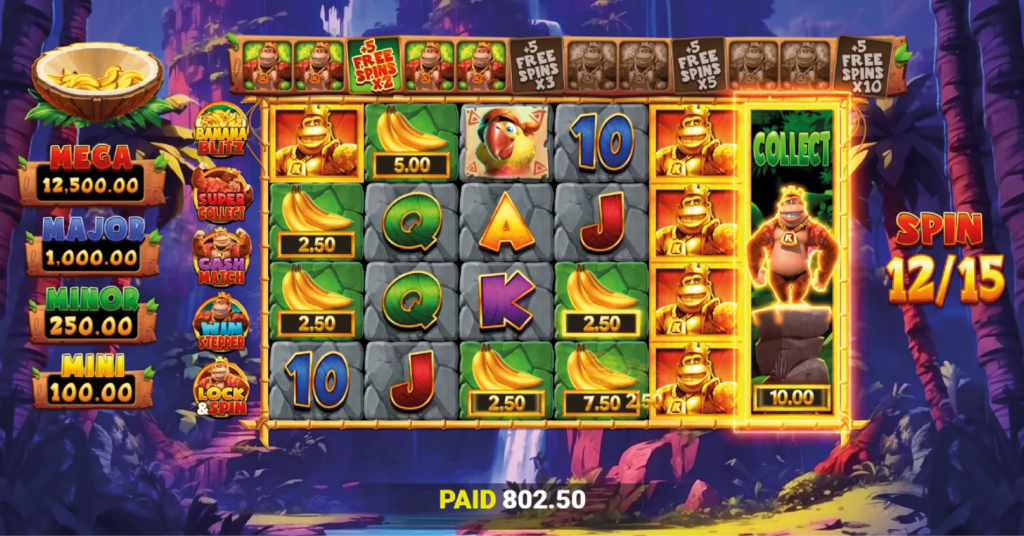
Bonus features are often described as the highlights of a slot, but it is more accurate to think of them as changes in tempo. In King Kong Cash, these moments do not arrive abruptly or without context. They emerge from the same mechanical framework that governs the base game, and their impact is best understood when observed across an extended demo session.
The transition from the base game into a feature is usually preceded by a subtle shift in attention. Scatter symbols begin to appear more frequently within a short span of spins, or partial combinations suggest the possibility of a trigger. These moments are not signals in a predictive sense, but they shape perception. The player becomes aware that the structure of the reels allows for an approaching change, even though the exact outcome remains uncertain.
When a feature does activate, the difference in pacing becomes immediately noticeable. Free spins, for example, often proceed with slightly altered timing, allowing the player to register each outcome more clearly. Animations may linger just long enough to emphasise the altered state of the game, but they do not disrupt the overall flow. The experience feels like a variation on the same rhythm rather than a separate game entirely.
In demo mode, these transitions can be studied without impatience. There is time to notice how frequently features appear over longer sequences, how long they tend to last, and how their results are distributed. Some features produce a series of modest returns that accumulate gradually, while others deliver a more concentrated sequence of outcomes. Observing these differences helps build a realistic sense of what the feature contributes to the overall session.
It is also worth paying attention to what happens immediately after a bonus round ends. In King Kong Cash, the return to the base game feels smooth and unforced. The reels resume their normal pace, and the visual language of the game settles back into its familiar pattern. This continuity prevents the session from feeling fragmented. Instead of a series of disconnected events, the experience retains a sense of progression.
Another detail that becomes clearer in demo play is the emotional temperature of these features. Without financial stakes, one can observe them almost clinically. The anticipation during the trigger, the steady unfolding of free spins, and the quiet return to the base game can all be experienced without the distraction of risk. This perspective reveals how carefully these sequences are structured to maintain engagement while preserving the overall balance of the slot.
Bonus features in King Kong Cash are not merely interruptions or spectacles. They are part of the broader rhythm of the game, rising and receding in a way that complements the base mechanics. Demo mode makes this relationship visible, allowing the player to see how each feature fits into the larger pattern of play.
A Full Session in Motion — What a Typical Demo Session Looks Like from Start to Finish
How a demo session usually unfolds (one clean loop)
This is the simplest way to visualise the pacing: a steady base-game run, a feature moment, then a return to normal play — repeating in cycles.
Load the game, set a stake, and establish the baseline pace.
Most of the time is spent here, where the slot builds its rhythm.
Short bursts of feedback mixed with calmer stretches between bigger moments.
A change of state begins (typically via scatters), shifting the tempo.
The feature plays out, often with a different rhythm and stronger outcomes.
The reels settle back into normal play and the cycle begins again. Repeat cycle
To understand any slot properly, it helps to step back from individual spins and look at the shape of an entire session. King Kong Cash reveals its character most clearly when viewed in this way, because its design is built around continuity rather than isolated moments.
A typical demo session begins quietly. The first several spins establish the pace of the reels and the frequency of small outcomes. During this phase, the player becomes accustomed to the timing of spins, the appearance of common symbols, and the pattern of minor returns. There is nothing dramatic in these opening moments, but they serve an important purpose: they set expectations and create a baseline for everything that follows.
As the session progresses, sequences of spins begin to form natural clusters. A short stretch of minimal activity may be followed by several spins that produce moderate line wins or visually interesting combinations. These clusters are rarely symmetrical or predictable, but over time they give the session a sense of movement, as though the game were advancing through distinct phases rather than remaining static.
Eventually, a feature is triggered. This marks the most noticeable shift in the session, not only because of the altered mechanics but also because of the change in pacing. The player’s attention sharpens, and each spin within the feature carries more weight. When the feature concludes, the session does not reset in any formal sense. Instead, it continues, returning to the familiar rhythm of the base game.
What follows is often another period of steady play. The reels resume their usual behaviour, producing a mixture of small wins, partial combinations, and occasional moments of anticipation. Over longer sessions, this cycle repeats several times: quiet stretches, moderate activity, a feature, and then a return to equilibrium.
Demo mode makes it possible to observe this entire arc without interruption. There is no need to stop after a loss or accelerate play after a win. The session unfolds at its natural pace, and the player can watch how the different phases connect to one another.
One of the most instructive aspects of this observation is the realisation that a slot is not defined by its most dramatic moments. The bonus rounds and larger wins occupy only a small portion of the total time spent playing. The greater part of the experience lies in the base game, in the steady turning of reels and the gradual accumulation of outcomes.
Seen from this perspective, a session of King Kong Cash resembles a continuous line rather than a series of isolated points. Each spin contributes to the overall texture of play, and the features serve as variations within that texture rather than departures from it. Demo play allows this continuity to become visible, revealing the structure that lies beneath the surface of the game.
What Demo Mode Reveals — Understanding the Behaviour of King Kong Cash Over Time
Four things demo play makes easy to spot
Same mechanics, clearer observation. Each card pairs what you notice with the specific reason demo mode helps.
The tempo of spins, pauses, and how the base game “breathes”.
Longer uninterrupted sessions make the rhythm easier to feel.
How often the session shifts into a feature state across normal play.
You can keep playing long enough to observe multiple cycles.
The spacing between meaningful events, not the outcome of any one spin.
No pressure from losses, so attention stays on the pattern.
Quiet phases and short clusters forming a natural ebb and flow.
Continuous play makes clusters and calm stretches easier to spot.
One of the greatest advantages of playing in demo mode is the ability to observe behaviour across longer stretches of play. A single spin reveals very little. Ten spins reveal only fragments. But after several hundred spins, patterns begin to emerge, not in outcomes, but in the way the game distributes activity and maintains engagement.
King Kong Cash is particularly interesting in this respect because its behaviour is consistent. The game does not rely on extreme swings to create interest. Instead, it maintains a balance between quiet periods and moderate activity, allowing the session to progress in a steady, readable way. This consistency becomes more apparent the longer one plays without interruption.
Volatility, a term often discussed but rarely understood, becomes clearer in this context. Rather than thinking of volatility as a promise of large or small wins, it is more useful to think of it as the spacing between meaningful events. In King Kong Cash, these intervals tend to be moderate. Features appear often enough to remain part of the experience, yet not so frequently that they lose their significance. Demo play makes this spacing visible in a way that short real-money sessions rarely do.
Another aspect that becomes easier to recognise is pacing. Over time, one begins to notice how the game regulates its tempo. After a sequence of active spins, the reels may settle into a quieter stretch. This is not a mechanical cycle in the strict sense, but it creates a rhythm that feels natural rather than abrupt. The alternation between activity and calm is one of the defining characteristics of the game.
Feature frequency is also easier to understand in demo mode. Rather than focusing on the outcome of a single bonus round, the player can observe how features are distributed across an entire session. Some arrive after relatively short intervals, others after longer periods of base play, but over time a general sense of their presence within the session begins to form. This broader perspective is far more informative than any isolated result.
Demo play also reveals subtler details of the game’s personality. The balance between small and moderate wins, the frequency of near misses, and the visual pacing of animations all contribute to an impression that is difficult to describe but easy to recognise once experienced. King Kong Cash feels measured, steady, and deliberate. It does not rush the player, nor does it leave the reels idle for long.
Perhaps the most valuable insight that demo mode provides is the understanding that a slot is not chaotic, even though its outcomes are random. There is structure in the distribution of events, structure in the pacing of spins, and structure in the way features are integrated into the session. Watching that structure unfold over time transforms the experience from a sequence of surprises into something more coherent and comprehensible.
For anyone interested in understanding how a slot behaves rather than merely how it pays, this perspective is invaluable. Demo mode turns observation into a meaningful part of play, and King Kong Cash rewards that attention with a clear and consistent behavioural pattern.
Practical Observations — Things to Know When Playing King Kong Cash for Fun
Beyond the mechanics and behavioural patterns, there are practical aspects of demo play that influence the overall experience. These details may seem small, but they shape how a session feels and how easily the player can focus on observing the game.
One of the most obvious differences between demo and real play is the flexibility of the virtual balance. In King Kong Cash, as in most modern slots, the balance can usually be reset at any time. This removes the need to interrupt a session or change stakes purely to extend play. It allows the player to maintain a steady pace, which is essential when trying to observe how the game behaves over longer sequences.
Autoplay is another feature that becomes particularly useful in demo mode. When used thoughtfully, it allows the player to watch the rhythm of the reels without the constant interruption of manual spins. This can make pacing and distribution patterns more noticeable, especially during extended sessions. At the same time, it is often helpful to pause autoplay periodically in order to reflect on what has occurred, rather than allowing the session to pass unnoticed.
Mobile play is also worth considering. King Kong Cash adapts well to smaller screens, and the clarity of symbols and animations remains intact. This consistency ensures that the experience of observing the game does not change significantly between desktop and mobile devices. The rhythm of play, the timing of spins, and the visibility of outcomes remain stable, which is important for anyone analysing the behaviour of the slot.
Another practical detail is loading and responsiveness. A smooth, uninterrupted session makes it easier to perceive patterns and pacing. When transitions are quick and animations flow naturally, attention remains focused on the reels rather than on the interface. King Kong Cash maintains this continuity effectively, allowing the session to proceed without unnecessary delays.
It is also worth noting that demo sessions can be as long or as short as the player chooses. There is no obligation to stop at any particular point, and this freedom encourages a more relaxed approach. Longer sessions, in particular, reveal aspects of the game that short bursts of play cannot capture, such as the gradual alternation between quiet and active phases.
Taken together, these practical considerations shape the experience of playing for fun. They create an environment in which observation becomes easier, patience comes naturally, and the structure of the game reveals itself over time. King Kong Cash responds well to this kind of attention, rewarding careful play not with guaranteed outcomes, but with clarity and understanding.
Questions Players Often Ask — King Kong Cash Play for Fun FAQ
Common Questions About Playing King Kong Cash in Demo Mode
Is demo mode different from real play?
Can bonus features appear in demo mode?
Does playing for fun help to understand the slot?
Can the demo balance be reset?
Understanding the Game by Watching It, Not Chasing It
After spending time with King Kong Cash in play-for-fun mode, what becomes most striking is not any single feature or outcome, but the coherence of the experience as a whole. The game is built in a way that reveals itself gradually. Its structure is not hidden, but it is quiet, and it rewards patience rather than haste.
Playing without financial pressure changes the quality of attention. Spins are no longer measured by immediate gain or loss, but by what they contribute to the unfolding session. In that calmer frame of mind, details that would otherwise pass unnoticed begin to stand out: the steady pacing of the base game, the spacing of features, the balance between activity and stillness on the reels. These are the elements that define how a slot truly behaves.
King Kong Cash demonstrates this particularly well because its design does not rely on excess. Animations are purposeful, features arrive with measured timing, and the rhythm of play remains consistent over long stretches. The game feels structured rather than chaotic, even though every spin remains independent. That sense of order is not an illusion; it is the product of carefully balanced mechanics working together over time.
What demo mode ultimately provides is perspective. It allows the player to see the game as a sequence, not as isolated moments. A feature is no longer just a sudden event, but part of a larger pattern. Quiet periods are no longer frustrating gaps, but natural intervals within the flow of play. The entire session begins to make sense as a continuous movement rather than a series of disconnected outcomes.
This understanding does not make the results predictable, nor does it change the fundamental nature of chance. What it changes is the way the game is perceived. When the structure behind the motion becomes visible, the experience feels more deliberate, more intelligible, and in many ways more satisfying.
For anyone who wishes to approach slots with a clearer eye, playing for fun is not merely an introduction. It is a way of learning how a game breathes, how it maintains its rhythm, and how its mechanics shape every moment on the reels. King Kong Cash, observed in this way, becomes more than a collection of symbols and spins. It becomes a system in motion, revealing its character slowly, patiently, and with remarkable clarity to those willing to watch.