
App King Kong Cash Slot – Mobile Play, RTP Structure and Feature Behaviour
App Environment vs Browser – What Actually Changes
When I analyse King Kong Cash inside an app environment, I begin with separation. The slot itself is one entity. The delivery channel is another. Confusion begins when those two are treated as interchangeable.
King Kong Cash runs on a defined mathematical model. That model governs reel outcomes, feature triggers, payout distribution and volatility behaviour. Whether the game is launched through a desktop browser, a mobile browser or a casino application, the internal logic does not recalculate itself according to device type. The spin is determined by the same probability structure.
What changes is the environment surrounding that spin.
A browser session tends to coexist with other stimuli. Multiple tabs, notifications, external distractions and wider screen spacing create natural interruptions. Even if they are minor, they dilute intensity. An app session, particularly on a smartphone, isolates the experience. The game occupies the entire visual field. There are fewer external prompts to disengage.
This environmental isolation does not modify expected return. It modifies immersion.
Immersion affects how a player interprets volatility. A sequence of uneventful spins on desktop may feel procedural. The same sequence in a full-screen mobile app can feel concentrated and continuous. When attention is fully enclosed, outcomes appear more decisive.
The environment therefore shapes perception, not mathematics.
There Is No “King Kong Cash App” – The Container Myth
One of the most persistent misunderstandings is the belief that there exists a separate, dedicated King Kong Cash application that behaves differently from the browser version. In practical terms, what most players download is a casino application. That application hosts a catalogue of games. King Kong Cash is one title within that library.
When the game loads inside the app, it is not rewritten. It is deployed within the same certified framework. The reels do not know whether they were launched from an icon on a home screen or a browser tab. They respond to the same random number generation system.
Why does this matter? Because attribution errors distort behaviour.
If a player believes the “app version” is tighter or looser, they may alter stake or session length based on that belief. When outcomes then follow ordinary variance patterns, confirmation bias can reinforce the assumption. The myth feeds itself.
In regulated environments, slot builds are tested and certified. The integrity of the random number generator is not conditional upon device type. Differences in outcome across platforms are either variance-driven or configuration-driven at operator level. They are not device-driven.
The container myth is attractive because it simplifies uncertainty. It is easier to say “the app is different” than to accept that short-term variance is unpredictable. But accepting variance is precisely what protects rational play.
Spin Rhythm on Mobile – Why Sessions Feel Faster
Mobile tempo, compared: app vs browser
The maths stay the same. What shifts is how quickly actions repeat and how tightly the session feels. This snapshot shows the practical differences you notice on a phone.
| Element | Browser | App | What it changes |
|---|---|---|---|
| Spin input | Cursor click | Thumb tap | Tempo |
| Session flow | Interrupted | Continuous | Immersion |
| Screen field | Wide | Compressed | Focus |
| Navigation | Multi-tab | Single-frame | Cognitive load |
What this means in practice: the app tends to compress the experience into a tighter loop. That can make streaks feel sharper, even though per-spin probability remains unchanged.
The most tangible difference between app and browser play is rhythm.
On a smartphone, the distance between intention and execution is minimal. A thumb tap initiates a spin instantly. Autoplay settings are often accessible with fewer clicks. There is no cursor travel across a wide screen. There is no scrolling to reposition the interface. These small efficiencies accumulate.
The result is compressed tempo.
Tempo does not alter probability. It alters emotional pacing. When spins follow one another rapidly, streaks become more visible. Five losing spins in quick succession feel sharper than five losing spins separated by pauses and distraction. Likewise, a bonus trigger that arrives within a rapid cycle feels explosive.
This is where players frequently misinterpret intensity as structural change. The slot appears more volatile because the outcomes are experienced in a tighter time frame.
From a mathematical perspective, nothing has shifted. From a psychological perspective, everything feels closer.
Rapid tempo also influences session duration. Mobile sessions are often shorter in clock time but denser in spin count. A player might complete the same number of spins in half the time compared with desktop play. That density magnifies variance exposure within a compressed window.
In simple terms: faster does not mean different. It means concentrated.
Portrait vs Landscape – How Screen Framing Changes Interpretation
Framing shift: landscape context vs portrait intensity
The same slot can feel different purely because the screen frames information differently. This concept view shows why landscape play often supports oversight, while portrait play tends to amplify immersion.
Desktop / Landscape
Analytical framing- Wider context around the reels
- Peripheral data stays visible
- Balance and controls feel stable
Mobile / Portrait
Emotional framing- Reels become centralised
- Less peripheral information on-screen
- Feature moments feel more dominant
What it explains: framing difference, immersion versus oversight, and the cognitive reason the same outcomes can feel sharper on a phone without any change in per-spin probability.
Screen orientation is a quiet but powerful variable.
In portrait mode, the reels dominate the vertical field. Peripheral information is reduced. The player’s focus narrows to symbol movement and immediate outcomes. The interface becomes a single column of action.
This centralisation increases emotional engagement. Near-miss patterns occupy a larger proportion of visible space. Scatter teases appear dramatic because they fill the field. The brain reads the event as prominent.
Landscape mode distributes information horizontally. Balance, stake and feature indicators sit comfortably at the edges. The experience becomes more panoramic. Players can track contextual information without shifting screens.
Neither orientation changes the slot’s volatility classification. But each orientation influences how volatility is felt.
Portrait mode often intensifies sensation. Landscape mode supports analysis.
The choice between them is not trivial. It reflects whether a player prefers immersion or oversight. Immersion amplifies the emotional peaks and troughs of King Kong Cash. Oversight moderates interpretation by keeping structural data visible.
Understanding this difference restores control. When a player recognises that framing affects feeling, they are less likely to misattribute sensation to structural change.
RTP in App Play – Fixed Mathematics, Variable Configuration
When discussion turns to mobile play, the question of RTP inevitably appears. Players want certainty. They want reassurance that the percentage advertised on a desktop site applies equally inside an app. The short answer is precise: device type does not alter theoretical return.
Return to player is embedded within the slot’s configuration. It represents a long-term statistical model derived from an extensive distribution of outcomes. In regulated markets, this model is certified. The device initiating a spin has no authority over that distribution. A touchscreen tap does not recalculate expectation.
However, configuration is a separate matter. In some jurisdictions, operators may select from permitted RTP bands when deploying a title. If a player switches from one operator’s browser to another operator’s app, and observes different long-term behaviour, the explanation may lie in configuration rather than platform. It is not the app that changes return. It is the operator’s chosen setting.
This distinction is crucial. Without it, rational evaluation becomes impossible. Players may compare a browser session at one site with an app session at another and conclude that “apps pay less.” In reality, they may simply be encountering two distinct authorised configurations, or more commonly, two short sessions that reflect variance rather than structure.
It is also important to emphasise time scale. RTP is not observable within a handful of spins. Nor is it reliably measurable within a few hundred. Mobile sessions tend to be brief. They begin and end before convergence can meaningfully emerge. Expectation remains theoretical unless exposure is extensive.
Therefore, when analysing King Kong Cash inside an app, the correct starting point is this: the mathematics are fixed. Perceived differences arise from configuration choice or session length, not from the device.
Volatility on Mobile – When Perception Outruns Structure
Volatility is frequently misunderstood as frequency of wins. In truth, volatility describes how returns are distributed. A medium-to-high volatility slot concentrates potential value into feature states or larger but less frequent payouts. A lower volatility slot distributes returns more evenly across base play.
King Kong Cash expresses much of its identity through defined feature layers. The bonus wheel, free spin modes and conditional enhancements act as variance concentrators. The base game establishes rhythm; the feature layer introduces contrast.
Inside an app, this contrast can feel sharper.
The reason is not structural change but perceptual intensity. Mobile play often occurs in short bursts. A player may open the app during a commute, play ten or twenty spins, then close it. Later in the day, they may repeat the process. Each session begins at an arbitrary point within the distribution curve. Few continue long enough to smooth variance.
When volatility is experienced in fragments, it appears extreme. If a short mobile session ends during a losing sequence, the slot feels harsh. If it ends immediately after a feature, the slot feels generous. The volatility classification has not changed. What has changed is exposure continuity.
Fragmentation distorts interpretation. The app encourages fragmentation because it is portable and convenient. Desktop play, by contrast, is often more deliberate and extended. Extended exposure tends to average outcomes more effectively within a single sitting.
The mobile environment therefore increases perceived volatility without altering actual volatility. It sharpens the edges of experience.
Exposure Compression – Why Short App Bursts Rarely Show Convergence
Exposure length vs volatility visibility
As spin count grows, the slot’s structure becomes easier to recognise. Short app bursts sit near the lower end of the curve, where variance dominates and RTP is not observable.
What it clarifies: short mobile sessions sit where structural clarity is low, so volatility feels sharper and RTP cannot be “seen”. More spins can increase clarity, but it never becomes certain within ordinary play.
Exposure compression is the structural consequence of mobile rhythm. In Step One, I described how app interfaces reduce friction and accelerate tempo. Here, I examine the statistical implication.
Imagine exposure as a continuum. At very low spin counts, variance dominates perception. Outcomes fluctuate widely relative to expectation. As spin count increases, volatility remains present but begins to distribute more predictably around the theoretical mean. Full convergence requires an extensive number of spins—far beyond typical recreational sessions.
Mobile bursts tend to cluster at the lower end of this continuum. Even if a player completes a similar number of spins per day as they would on desktop, those spins are divided into shorter sessions. Each session resets psychological expectation. The player does not experience gradual smoothing within a single coherent frame; instead, they experience repeated entry points into uncertainty.
To conceptualise this, consider a simple model.
Title: Exposure Length vs Structural Clarity
X-axis: Number of Spins
Y-axis: Visibility of Distribution Pattern
At minimal spins, clarity is low. Outcomes appear random and disconnected. As spins accumulate, pattern recognition increases. The line rises gradually, not sharply, and never reaches certainty because variance never disappears entirely.
Mobile play often remains within the initial incline of the graph. It samples early-stage volatility repeatedly rather than progressing far enough along the axis to perceive distribution balance.
This is not a criticism of mobile play. It is an observation about session structure. If a player understands that short bursts exaggerate volatility visibility, they are less likely to draw incorrect conclusions about fairness or performance.
App Versus Browser – A Structural Comparison
A clean structural comparison: app versus browser
This closes the RTP myth neatly: the core maths do not change. What changes is the session pattern and the way volatility is perceived through tempo and fragmentation.
| Parameter | App | Browser | Mathematical impact |
|---|---|---|---|
| RTP | Same | Same | None |
| Volatility | Same | Same | None |
| Session pattern | Fragmented | Extended | Perception shift |
| Tempo | Faster | Moderate | Emotional intensity |
What it explains: the app does not change RTP or volatility, but it can change how risk feels by compressing time and fragmenting exposure.
Emotional Feedback Loops in Mobile Play
There is one additional layer worth examining: feedback density.
Mobile devices often integrate sound, vibration and animation in a tightly synchronised manner. A small win triggers immediate visual and auditory confirmation. A feature tease may include intensified sound cues. Because the device is held close, these cues feel personal.
Feedback density increases emotional response. It shortens the loop between action and sensation. When the loop is short, reinforcement—positive or negative—feels stronger.
Yet reinforcement does not equate to altered probability. It influences behaviour. A player who feels heightened anticipation may continue longer in pursuit of resolution. A player who experiences rapid loss feedback may chase recovery within the same compressed session.
Understanding feedback density is part of understanding mobile volatility perception. The slot does not know it is being held in a hand. The player does.
The Illusion of Device-Based Patterns
Players sometimes report anecdotal patterns: “I win more on desktop,” or “The app never gives me bonuses.” These statements arise from selective memory and context bias.
If mobile sessions are typically brief and desktop sessions longer, the desktop environment is more likely to include at least one feature within a sitting. The player may then attribute that frequency to the device rather than to session length.
Similarly, if mobile play occurs during idle moments—on a train platform or during a break—the player may be less attentive to balance management and more sensitive to loss. Memory encodes those moments as negative patterns.
From a structural standpoint, there is no mechanism within certified slot design that detects device category and alters outcome distribution accordingly. The idea persists because human memory privileges emotion over data.
Feature Behaviour on a Small Screen – When the Bonus Becomes the Centre of Gravity
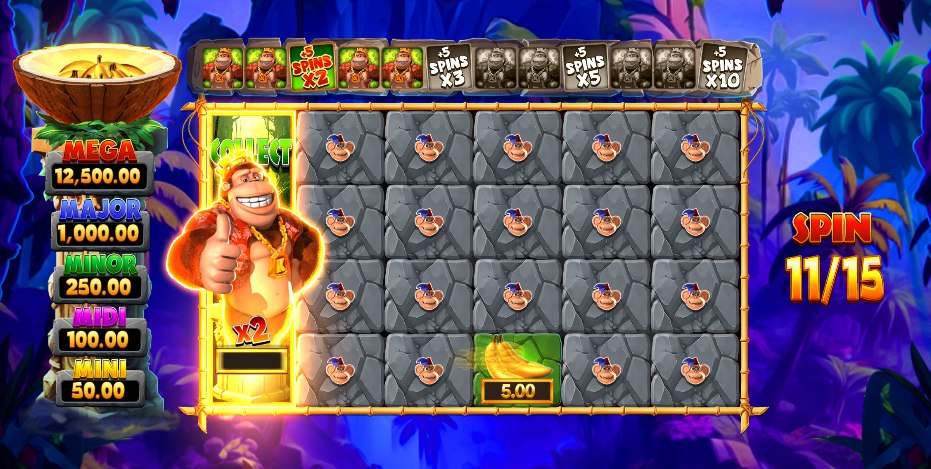
King Kong Cash is not defined purely by its base spins. Its character emerges most clearly when the feature layer activates. The bonus wheel, free spins modes and conditional enhancements concentrate variance into short, decisive sequences. On desktop, those sequences are part of a wider visual field. Inside a mobile app, they become the centre of gravity.
The smaller screen does not alter trigger probability. It alters visual dominance.
When the wheel activates on a smartphone, it frequently occupies the majority of the screen. Peripheral elements recede. Balance indicators and navigation controls become secondary. The event feels isolated, self-contained and heightened. This framing increases perceived importance.
The human mind assigns weight based on scale and focus. If an event occupies most of the visible frame, it feels significant. The bonus state therefore appears more dramatic in the app environment, not because it is rarer or more frequent, but because it is framed as the primary object of attention.
This matters behaviourally. Players often remember the feature moment more vividly than the base spins that preceded it. In a compressed mobile session, the feature may represent the emotional peak of the entire interaction. Its intensity becomes amplified by proximity and scale.
On desktop, the same feature may feel integrated into a broader context. On mobile, it feels central and immersive.
Free Spins Readability – Information Density Under Compression
Free spins sequences typically introduce layered information: multipliers, cumulative win counters, modified reels or conditional mechanics. On a larger screen, these elements can coexist comfortably. On a smaller screen, they must be prioritised.
App interfaces often solve this by layering information sequentially. A win counter may animate briefly, then fade. A multiplier may appear prominently during evaluation, then recede. The player’s attention is guided rather than left to scan.
This guidance can simplify interpretation for some players. It reduces clutter and creates a clean visual hierarchy. For others, it compresses contextual awareness. If balance movement and stake size are not permanently visible in peripheral space, the player may rely more heavily on impression than calculation.
Clarity of information affects decision-making. If cumulative free spin totals are clearly displayed and persistently visible, the player remains anchored to numerical reality. If those totals appear briefly and are replaced by animation, the emotional tone may dominate interpretation.
It is important to note that none of these interface adjustments change the underlying payout calculation. The free spin mode retains its predefined distribution. However, the clarity with which that distribution is observed changes according to screen design.
Landscape orientation typically restores more analytical visibility. Portrait orientation prioritises immersion and centralised animation. Each mode offers a different balance between engagement and oversight.
A player aware of this difference can choose intentionally rather than reactively.
Near-Miss Intensity – The “Almost” Illusion in a Narrow Frame
How the “almost” feels: desktop versus mobile framing
The event is the same. The screen makes it feel different. This mini table keeps the focus on presentation rather than probability.
| Feature element | Desktop | Mobile | Perception effect |
|---|---|---|---|
| Near miss | Peripheral | Dominant | Increased anticipation |
| Scatter tease | Contextual | Centralised | Heightened tension |
| Bonus wheel | Framed | Immersive | Emotional amplification |
What it explains: presentation shifts feeling without changing per-spin odds, and it supports the cognitive analysis without repeating the larger structural table.
Near-miss events are inherent to slot structure. A reel may stop one position above a scatter symbol. Two bonus symbols may appear with a third just outside the payline. These outcomes are not predictive. They do not indicate increased probability on subsequent spins. They are statistically neutral events within the distribution.
However, visual framing influences how near-misses are perceived.
On a small screen in portrait mode, the reels dominate the field. A near-miss occupies a larger percentage of the visible area than it would on a wide desktop monitor. The proximity feels physical rather than abstract.
Sound design and animation can further amplify this perception. A slight delay before the final reel stops, or a subtle audio cue when two scatters land, heightens anticipation. On a mobile device held close to the face, these cues feel intimate.
Intimacy intensifies emotional response.
From a structural standpoint, the probability of triggering a feature on the next spin remains unchanged. Yet the sensation of proximity may encourage continuation. The player feels close to an event, even though closeness is illusory in probabilistic terms.
Understanding the “almost” illusion is critical in mobile environments. The app enhances immediacy. It does not introduce momentum between spins.
Autoplay, Turbo and Stake Switching – Control Under Pressure
Mobile apps frequently make control features accessible through compact menus. Autoplay settings, turbo mode and stake adjustments can be reached within one or two taps. This efficiency reduces friction.
Reduced friction increases responsiveness.
If a player experiences a feature trigger and wishes to increase stake, the app allows rapid adjustment. If a losing streak begins, autoplay can be stopped instantly. These controls create a sense of agency.
Agency, however, must be distinguished from influence. Changing stake size alters payout scale and exposure rate. It does not alter trigger probability per spin. Autoplay accelerates rhythm. It does not affect outcome independence.
In mobile contexts, rapid control shifts can occur within seconds of emotional reaction. A player may raise stake immediately after a bonus, interpreting the event as a signal. Alternatively, they may double stake during a dry stretch, hoping to compress recovery.
The speed of adjustment increases behavioural volatility, not mathematical volatility.
Desktop play, with its broader interface and slower transitions, may introduce slight pauses before such decisions. Those pauses can act as natural regulators. Mobile play removes many of them.
Recognising this difference allows for deliberate control. The app does not compel reactive behaviour, but it facilitates it.
Feature Layer Versus Screen Density
Feature elements under screen compression
This comparison shows how the same feature layer reads differently depending on screen context. The structure stays fixed; presentation shifts how it feels.
| Feature element | Larger screen context | Mobile app context | Perception impact |
|---|---|---|---|
| Bonus wheel | Framed within full interface | Centralised and dominant | Heightened emotional focus |
| Free spin counter | Stable and peripheral | Animated and layered | Sensation over calculation |
| Near-miss configuration | One element among many | Visually amplified | Increased anticipation |
| Control settings | Spread across interface | Compact and immediate | Faster behavioural shifts |
Why it matters: the app does not change probability, but it can intensify how variance is experienced by centralising features and compressing feedback.
Sensory Feedback and Memory Encoding
Mobile devices integrate sound and haptic feedback tightly with visual animation. A small win may trigger a brief vibration. A bonus activation may be accompanied by intensified audio cues. Because the device is physically held, these sensations feel direct.
Direct sensation strengthens memory encoding. A vivid bonus sequence on mobile may be remembered more strongly than a similar sequence on desktop. That memory can influence expectations in future sessions.
If a player recalls a dramatic mobile feature, they may associate the app environment with heightened opportunity. Conversely, if they recall a sharp losing streak experienced in rapid tempo, they may associate the app with increased risk.
Memory, not mathematics, drives these associations.
Slots operate through independent events. Memory operates through emotional imprint. The app amplifies imprint by increasing proximity and sensory density.
Understanding this distinction preserves structural clarity.
Why Feature Centralisation Does Not Increase Frequency
It is tempting to assume that because bonuses feel more prominent on mobile, they may occur more often. Prominence is not frequency.
The probability of landing triggering symbols remains fixed within the game’s configuration. The wheel does not spin more frequently because it appears larger on a small screen. The free spins mode does not activate more often because the app animates it dramatically.
Frequency is determined by coded distribution parameters. Visibility is determined by interface design.
When players separate these two factors, they regain perspective. The slot behaves according to its certified model. The app magnifies its theatrical elements.
Security and Integrity in Apps – What Remains Structurally Constant
When discussion shifts from reels to environment, security becomes part of the analysis. A casino app is not merely a visual wrapper; it is a software ecosystem. It manages authentication, balance tracking, encryption and communication between device and server. That complexity can give the impression that more variables are in play.
Yet from a structural perspective, King Kong Cash remains governed by the same certified mathematical model regardless of delivery channel.
In regulated markets, slot software is audited and tested to confirm randomness, payout distribution and volatility classification. These certifications apply to the game build itself, not to the screen on which it is displayed. The random number generator does not read device type before producing an outcome. It does not distinguish between a browser request and an in-app request in probabilistic terms.
The integrity of the slot is therefore device-agnostic.
The app may introduce additional layers of encryption or authentication. It may store session tokens differently from a browser. It may integrate biometric login or two-factor verification. These elements protect account access and data security. They do not alter reel behaviour.
It is important to maintain this boundary. When players experience unexpected outcomes, the instinct is sometimes to suspect interference. Structural integrity testing exists precisely to prevent such interference. Certified slots operate under predefined distribution logic that cannot be modified dynamically according to device.
Security measures may vary. Probability does not.
Privacy and App Ecosystems – What Changes Around the Slot
While the slot’s mathematics remain constant, the ecosystem surrounding it can differ meaningfully between browser and app environments.
An app may request certain device permissions. It may track session activity for performance optimisation or compliance purposes. Updates are distributed through app store channels rather than web deployment. These operational details influence the broader experience of playing, though not the internal mechanics of King Kong Cash.
For example, persistent login within an app reduces friction between sessions. A player may reopen the app and resume play within seconds. In a browser, they might re-enter credentials or navigate through additional steps. Convenience alters behavioural patterns.
Push notifications represent another ecosystem difference. An app may deliver promotional alerts or reminders. A browser does so less frequently unless notifications are explicitly enabled. These prompts can influence when and how often a player engages with the slot.
Again, these elements affect exposure frequency, not spin probability.
Privacy settings and data transparency vary by jurisdiction and operator. Responsible players review these policies, understanding what information is collected and how it is used. Such awareness strengthens confidence in platform integrity without confusing operational data handling with mathematical fairness.
The slot remains constant. The surrounding ecosystem shapes interaction cadence.
Behavioural Risk on Mobile – Convenience as a Structural Amplifier
How convenience reshapes perception
A mobile app does not change RTP or per-spin probability. What it can change is behaviour: shorter sessions, fragmented exposure, and sharper-feeling variance.
Mobile convenience
Instant access, persistent login, minimal friction.
Short sessions
Play happens in quick bursts across the day.
Fragmented exposure
Each burst samples only a small slice of the distribution.
Heightened perceived volatility
Variance feels sharper even though the maths remain unchanged.
Mobile convenience is neither inherently positive nor inherently negative. It is powerful.
A smartphone travels everywhere. It turns potential downtime into playable time. A player may initiate a session during a short break, in transit, or while waiting in a queue. These spontaneous sessions differ from deliberate desktop play conducted in a fixed location.
Spontaneity increases exposure fragmentation. As discussed earlier, fragmented exposure heightens perceived volatility. It also increases cumulative spin count across a day or week without necessarily feeling substantial in each individual burst.
Ten spins here and fifteen there appear modest. Combined, they represent significant exposure. The slot’s risk profile has not changed, but behavioural patterns have expanded total variance experienced.
Convenience can therefore act as a structural amplifier. It does not alter payout percentage or feature probability, yet it increases the number of independent events a player encounters. More events mean more opportunities for both gain and loss. Variance remains neutral; volume grows.
Responsible engagement requires recognition of this amplification effect. The app makes access easy. Discipline must compensate for ease.
Session Architecture – Desktop Intention Versus Mobile Fluidity
Desktop sessions often begin with intention. A player sits at a computer, logs in, selects a game and commits to a defined period of play. The environment encourages continuity.
Mobile sessions are fluid. They begin quickly and end abruptly. Interruptions are common. The device may vibrate with unrelated notifications mid-spin. Attention shifts more frequently.
This fluidity can reduce reflective decision-making. Rapid re-entry into the app after a pause may occur without conscious planning. Stake adjustments may be made reactively rather than strategically.
Yet the slot itself remains consistent. Each spin is independent. Each trigger is conditional. The fluidity affects how players manage sessions, not how the reels determine outcomes.
Understanding session architecture is essential for maintaining structural perspective. The app changes context. It does not introduce hidden variables into the game’s core.
Why It Feels Different but Isn’t – The Final Structural Frame
After examining environment, mathematics and feature presentation, one conclusion becomes unavoidable: King Kong Cash inside an app feels different because the frame has changed, not because the slot has.
The app centralises visuals. It compresses tempo. It enhances sensory feedback. It facilitates spontaneous sessions. These elements intensify perception.
Perception, however, is not probability.
The wheel does not spin more frequently because it fills the screen. Free spins do not pay differently because they are triggered by a thumb rather than a mouse. RTP does not adjust itself according to operating system.
What changes is immersion.
Immersion heightens emotional response to variance. Variance then shapes memory. Memory influences expectation. Expectation colours future interpretation.
When players conflate immersion with structural change, they risk drawing incorrect conclusions about fairness or performance. When they separate the two, clarity returns.
The app is a lens. The slot is the object viewed through that lens. Changing the lens can sharpen contrast or alter perspective, but it does not alter the object’s internal composition.
Structural Summary
App Impact: Environmental and behavioural
RTP Change: None
Volatility Classification: Unaltered
Spin Independence: Preserved
Exposure Pattern: Often fragmented and accelerated
FAQ About King Kong Cash Slot App
Frequently Asked Questions
Is there an official standalone King Kong Cash app?
Does playing in an app change the RTP?
Is the slot more volatile inside an app?
Do bonuses trigger more often on mobile?
Is autoplay different in the app version?
Is security the same in app and browser play?
Same Mathematics, Different Experience
King Kong Cash inside an app environment is not a different game. It is the same structured slot viewed through a more concentrated lens.
The app modifies rhythm, framing and accessibility. It compresses tempo. It centralises visuals. It enhances sensory feedback. These changes intensify perception. They can make volatility feel sharper and features feel more dramatic.
But perception must not be confused with probability.
RTP remains configuration-based. Volatility classification remains intact. Each spin remains independent. The wheel does not favour mobile devices. Free spins do not discriminate between touchscreen and cursor.
What the app genuinely changes is behavioural architecture. It encourages shorter, more frequent sessions. It reduces friction between intention and action. It amplifies immersion. These factors increase exposure density and emotional response, but they do not alter the slot’s core mechanics.
Clarity lies in separation. When you separate environment from mathematics, the experience becomes easier to interpret. King Kong Cash does not transform inside an app. It simply feels closer.
Understanding that distinction allows you to engage with the game on informed terms. The screen may shrink. The tempo may accelerate. The structure remains exactly as designed.